Inside Galaxy, China’s 800MW Wind-Powered Data Center Campus in Inner Mongolia
Envision’s Galaxy campus pairs dedicated wind, battery storage and an 800V DC pilot, with an 800MW plan and a 120MW first phase.
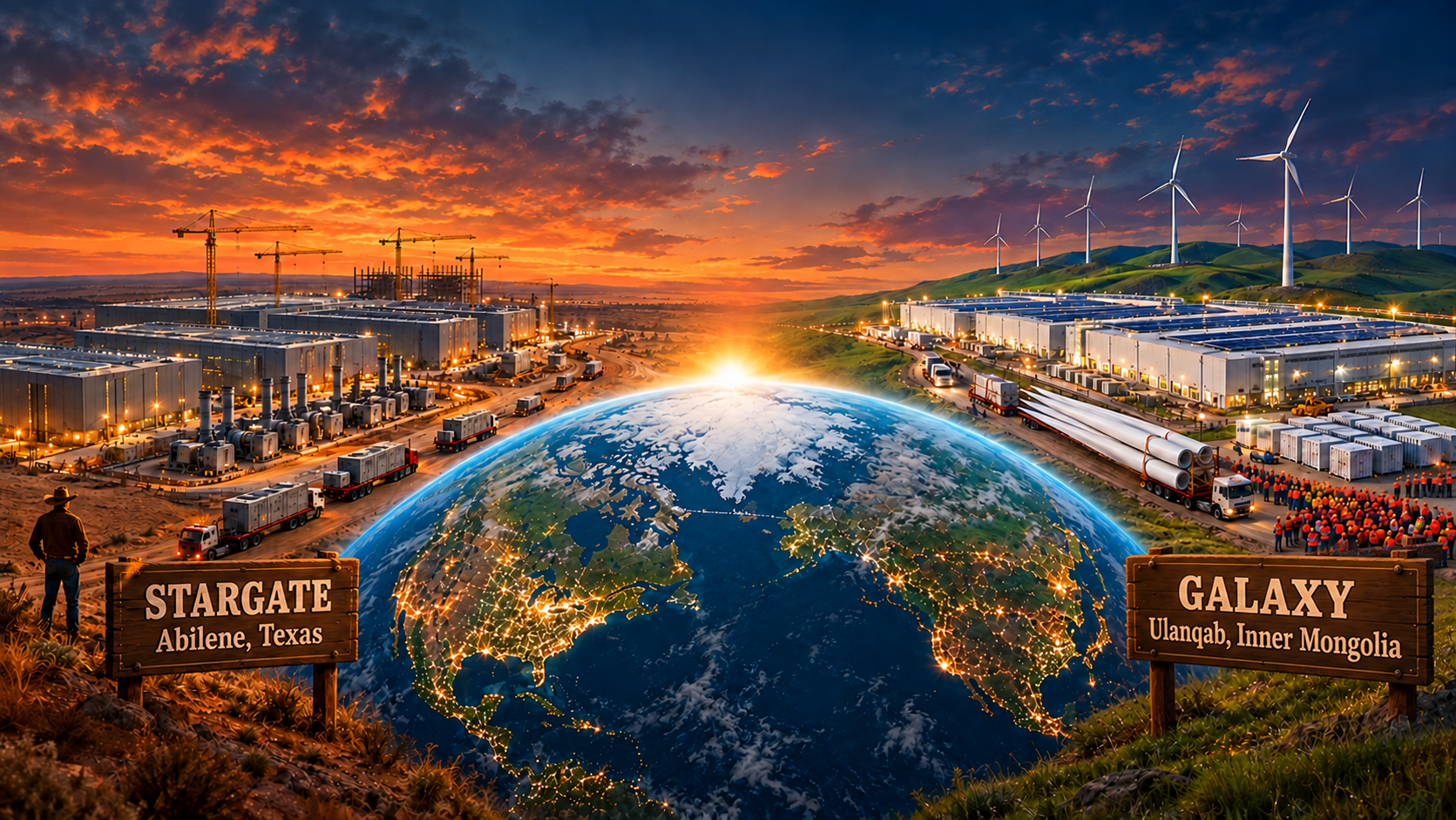
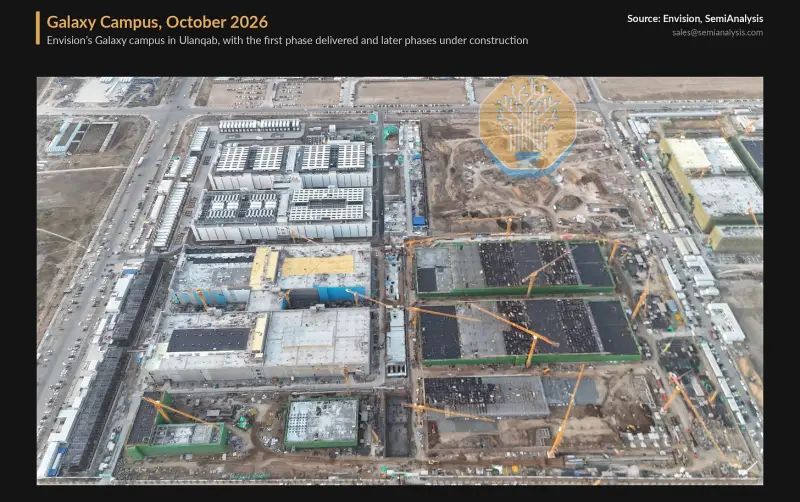
Galaxy shows what changes when a data center developer also makes power equipment and builds renewable generation. Envision’s campus in Ulanqab, Inner Mongolia, is planned for up to 800MW of IT capacity. Its first 120MW phase was delivered in under a year, and the site combines dedicated wind generation, battery storage and an 800V DC power pilot.
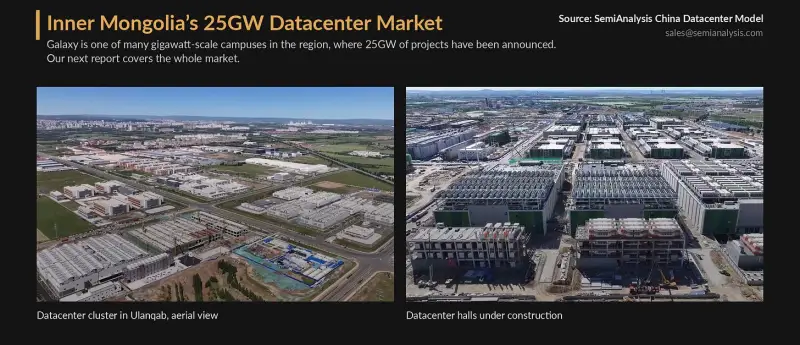
That mix makes Galaxy a useful reference for engineers tracking high-density computing infrastructure. The project brings energy supply and data center design together, while its construction and equipment choices point to a different route from the more modular approach common in some other markets. The campus was still expanding during a September visit; local reporting put nearly 30,000 construction workers across 22 data center projects in the surrounding Chahar High-tech Zone.
Campus scale and construction
Galaxy’s planned 800MW IT capacity puts it in the same broad class as the central campus at Stargate in Abilene, Texas. Crusoe describes Abilene as an eight-building, 1.2GW campus, equivalent to about 820MW of critical IT capacity. Galaxy is therefore among China’s largest single-campus projects. Both developments were conceived by companies with roots in energy and were planned around dedicated power resources: Abilene draws on the grid and on-site gas turbines, while Galaxy relies largely on wind.
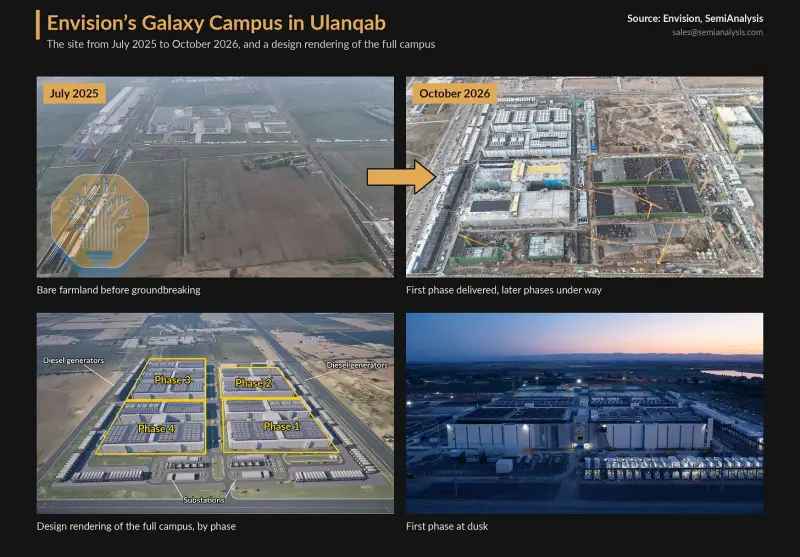
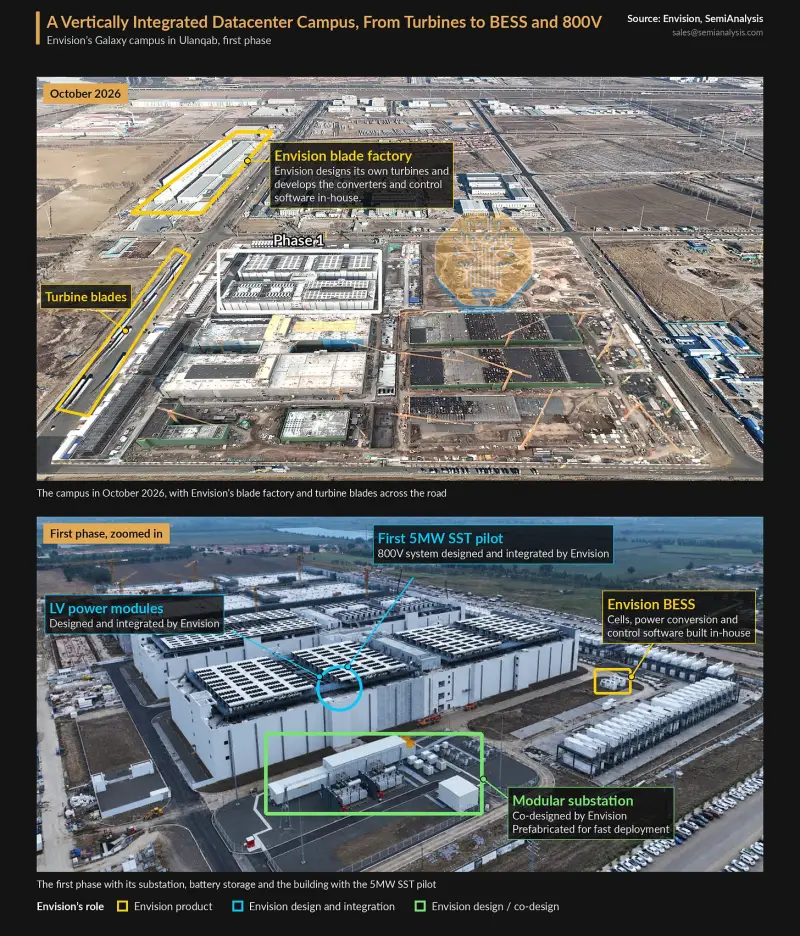
Envision’s initial 120MW phase was delivered within a year at about one-fifth of US costs, according to the project account. The full campus is expected to be completed by the end of 2027. Envision has outlined 3GW of data center plans in Inner Mongolia, with Galaxy as its first project. The campus may also have room to expand: converting the neighboring wind-turbine factory could enable a later phase taking total capacity to roughly 1GW.
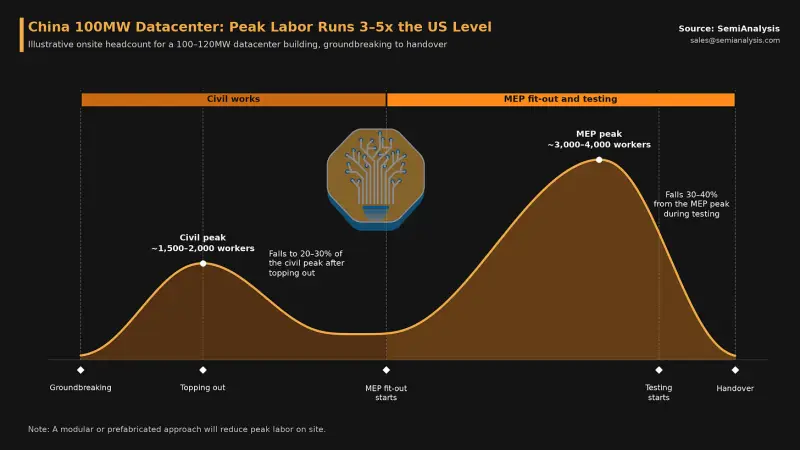
All four planned phases are built to suit two large internet companies. The site visit found the remaining campus under active construction. The project account links the pace and cost to a construction environment with abundant labor and falling construction costs. Chinese data centers in this setting rarely rely on fully modular construction. That choice shapes how project teams divide work between factory preparation and on-site building.
Energy supply tied to the computing load
Galaxy follows a model known in China as source-grid-load-storage: generation, a dedicated connection, the data center load and battery storage are developed as one system. Rather than relying solely on the public grid, a project builds wind or solar generation and connects it directly to the computing site. For operators, the approach can provide long-term electricity at a largely fixed cost, while renewable generation can contribute toward green-energy targets.
Inner Mongolia has about 57% of China’s usable wind resources. A typical wind farm there runs about 2,800 full-load hours per year, equivalent to a capacity factor of roughly 32%. Ulanqab is windier, with a reported capacity factor of 35–40%. Envision aims for its own wind farms to supply more than 60% of the electricity used by Galaxy’s first two phases.
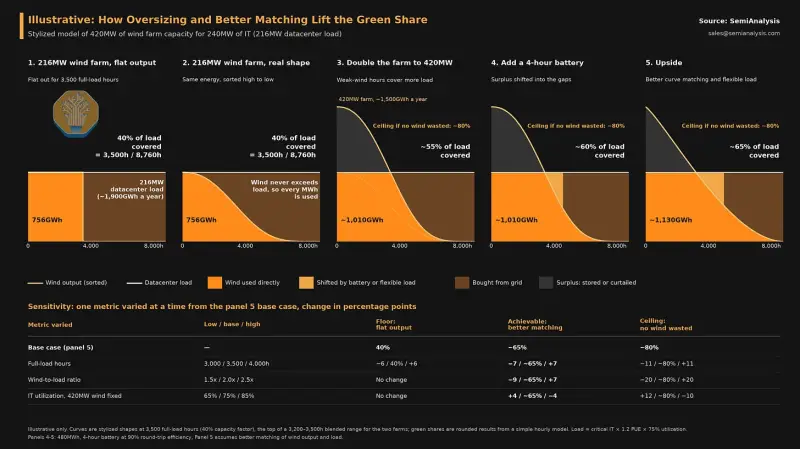
Three design choices support that target. First, Envision selected windy locations about two hours’ drive from the campus. The two wind farms sit around 80km apart, reducing the number of hours when both are calm. Second, their combined installed capacity is 420MW, about 1.75 times the 240MW load cited for the data center. Oversizing generation helps cover demand during lighter-wind periods, though it also creates surplus when output exceeds the site’s needs.
Third, a four-hour battery system shifts some electricity from windy periods into calmer hours. Storage can smooth short gaps, but it cannot carry a site through several windless days on its own. The design therefore depends on matching wind resources, generation capacity, storage and the data center’s load profile. Any surplus that cannot be stored or consumed must be curtailed or handled by another part of the supply arrangement.
An illustrative comparison in the project account shows why simply matching wind capacity to data center load is insufficient for a high renewable share. With wind capacity equal to the load, the site can use all the generation yet wind supplies about 40% of annual energy. Doubling wind capacity raises that illustrative share to about 55%, because even low-output hours contribute more. A four-hour battery can shift some surplus into later hours, and better alignment between generation and demand can raise the share further.
Envision’s role inside the facility
Envision entered data centers from renewable energy and energy management. The company has installed more than 100GW of wind turbines worldwide, and its work spans generation, storage and the electrical systems that connect them to computing loads. Its affiliate, Envision AESC, develops batteries, energy storage systems, power electronics and control software.
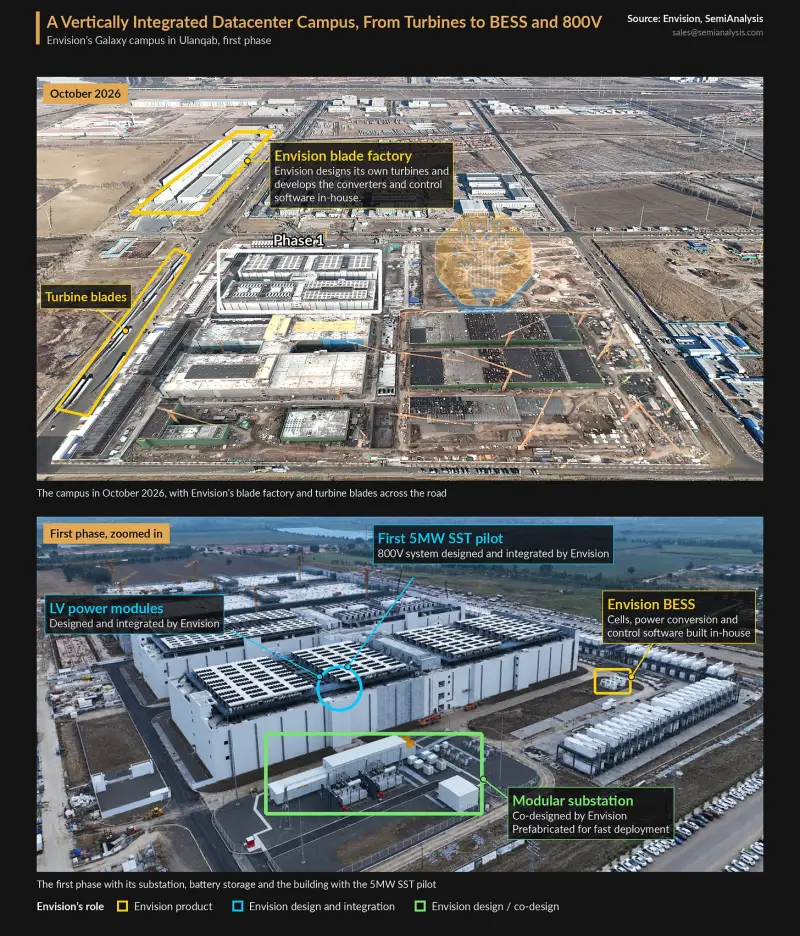
That background is visible across Galaxy. Envision builds wind farms and a dedicated power line, and a blade factory stands across the road from the campus. Inside the site, the company designed and integrated low-voltage power modules and the 800V system, while AESC supplied battery storage. Envision also co-designed the prefabricated substation.
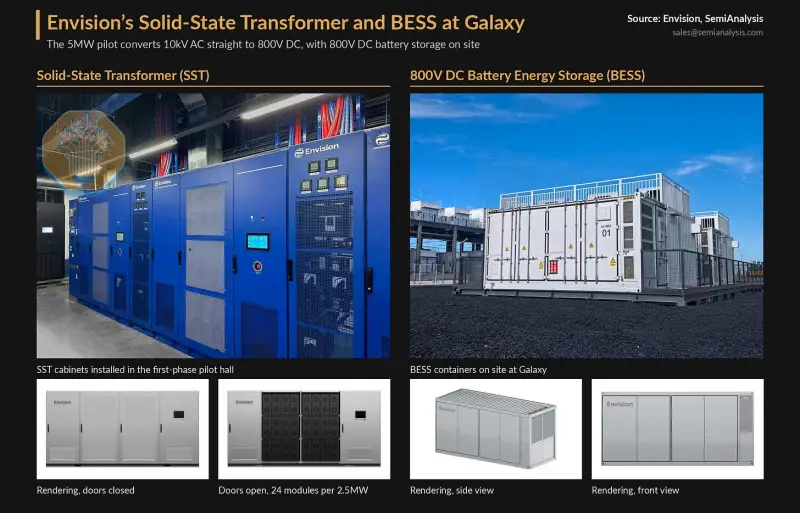
Factory integration is one of the project’s main engineering claims. AESC makes major storage-system components in-house, from battery cells to power conversion and software, allowing the complete system to be configured and tested together before shipment. Many suppliers specialize in one part of a power system, leaving teams to resolve interfaces during site commissioning. The project account says that process can take three to six months; factory configuration is intended to reduce that burden.
The prefabricated substation follows the same logic. Modules are built and tested in a factory while civil work proceeds at the campus, then transported and connected on site. Envision’s stated schedule is less than three months, compared with about six months for a conventional indoor substation. The time saving depends on coordinating factory production and site preparation so the modules arrive when the connection work can proceed.
An 800V DC pilot at rack level
One 5MW hall uses solid-state transformers to convert 10kV AC from the grid directly to 800V DC for the racks. The arrangement removes intermediate low-voltage transformers, uninterruptible power supply equipment and rectifier stages. It is a live pilot, not yet the full-campus architecture, but it demonstrates the direct medium-voltage-to-DC path at a hyperscale site.
The design builds on a longer history of DC data center power in China. China Telecom began 240V DC pilots in 2007, and Alibaba used its Panama power system in 2018. The project account estimates that roughly a quarter of Chinese data centers built during the past decade use DC, while about 97% of US data centers still use AC UPS systems.
Higher-voltage DC is drawing attention as rack power density rises. The account points to Nvidia’s planned architecture and Kyber racks around 600kW as drivers for reconsidering today’s power distribution. In this view, solid-state transformers are a further step: they take medium-voltage AC and supply 800V DC without the conventional sequence of conversion stages. A larger version of Galaxy’s pilot is planned for a later phase.
Cooling without a central chiller plant
Galaxy uses a cooling arrangement found elsewhere in Inner Mongolia: liquid-cooled and air-cooled servers share a water loop, with no central chiller plant. That choice matters because facilities often retain chillers to serve air-cooled equipment and to preserve the option of changing the balance between air and liquid cooling.
The project account notes that Nvidia says Vera Rubin can operate with 45°C water without chillers. Galaxy’s approach combines that higher-temperature liquid cooling with a shared loop and omits the central chiller. It has been operating at scale in northern China for years, providing a field example for teams evaluating cooling designs as rack heat loads rise. The practical question is how a facility’s mix of equipment and operating needs fits the shared loop over time.
Why vertical integration may matter
Envision’s approach reflects a wider shift among Chinese industrial companies with experience in energy, construction or electrical equipment. Data center project returns are under pressure, so developers may value the demand created for equipment and services they already supply. In Envision’s case, the campus creates a large load for its wind generation, storage and power systems.
Another example links VNET, battery maker CATL and power-system supplier Zhongheng Electric. VNET is a data center operator; CATL makes batteries; and Zhongheng supplies high-voltage DC systems for data centers, including work with Alibaba and ByteDance. In 2026, CATL became VNET’s largest shareholder and agreed to take a 49% stake in Zhongheng Electric’s controlling shareholder. CATL and VNET then agreed to develop gigawatt-scale campuses, while CATL and Zhongheng planned work on data center power systems. The structure connects data center operations, renewable power and storage, and electrical conversion inside the facility.
Galaxy’s market context is unusually cost-sensitive. Data center rents in China have roughly halved over five years to about $40/kW/month, excluding electricity. Capital expenditure has fallen about 25% over the same period to less than $3 million per MW. Electricity in Inner Mongolia costs about $0.055/kWh all-in. In that environment, controlling more of the equipment and supply chain could help manage cost and schedule.
But vertical integration has not yet become a deciding factor for large customers. The project account says customers still focus mainly on available resources and a developer’s track record. That may change as access to electricity grows more difficult and data center power architecture shifts toward higher-voltage DC, battery backup units and battery storage systems. Galaxy’s value as a reference lies in having those ideas operating together at one campus: dedicated wind, storage, prefabricated electrical infrastructure, an 800V DC pilot and a cooling loop without a central chiller plant.
The next engineering questions are practical: how reliably the wind-and-storage system matches the campus load, how the 5MW power pilot scales, and how the cooling arrangement performs as more phases come online. Galaxy offers a working point of comparison for those decisions, while its expansion schedule will show how the integrated design holds up at greater capacity.
 AMD Venice Uses 2.5D Packaging to Feed More Bandwidth Into EPYC Zen 6
 CNC Controller Board Design: Interfaces, PCB Specs and Assembly Testing
 Stratasys and Nano Dimension End $42.5 Million Markforged Sale Agreement