Electric Motor Array Recreates Muscle-Like Coordination Through a Shared Mechanical Backbone
A tabletop motor array develops load response, slipping and travelling coordination waves without direct communication between its motors.
A shared mechanical backbone can help simple electric motors coordinate their motion, without each motor receiving instructions from a central controller. A University of Bristol team found that a mathematical model and a tabletop device both produced behaviours associated with muscle, including changes in load response, sudden slips and travelling waves of activity.
The result points to a design principle with potential relevance for robotics: the structure connecting actuators can shape how they work together. That could matter for machines that need many actuators to produce smooth, adaptable movement, especially where added sensing, control loops and complex gearing bring cost and potential failure points.
A mechanical model of muscle
Muscle generates force through sarcomeres, its smallest force-producing units. Each sarcomere contains actin filaments and myosin molecular motors, which together form the actomyosin system. Myosin motors repeatedly attach to actin, pull and detach. In everyday movement, many such actions combine to maintain force or change it as the load shifts.
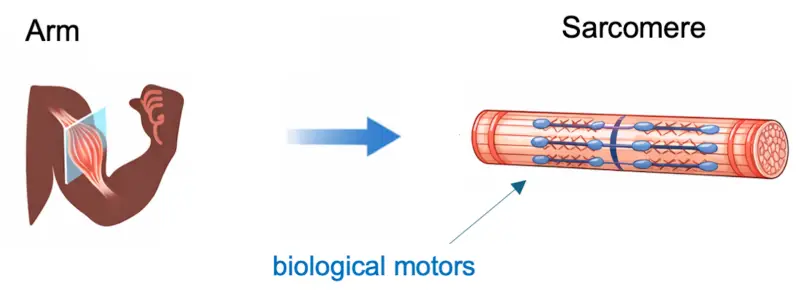 Illustration showing the sarcomere, the smallest functional unit of muscle.
The team’s model leaves out the detailed chemical cycle that powers myosin. Instead, it represents each force-producing unit as a cycling rotor. A rotor contributes force only while mechanically engaged with a shared backbone; when it disengages, it acts independently. This simplification let the researchers examine whether mechanical coupling alone could produce coordinated behaviour.
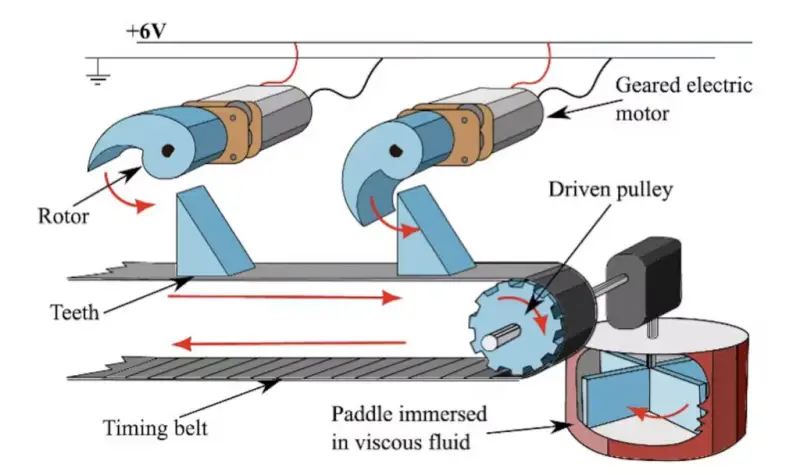
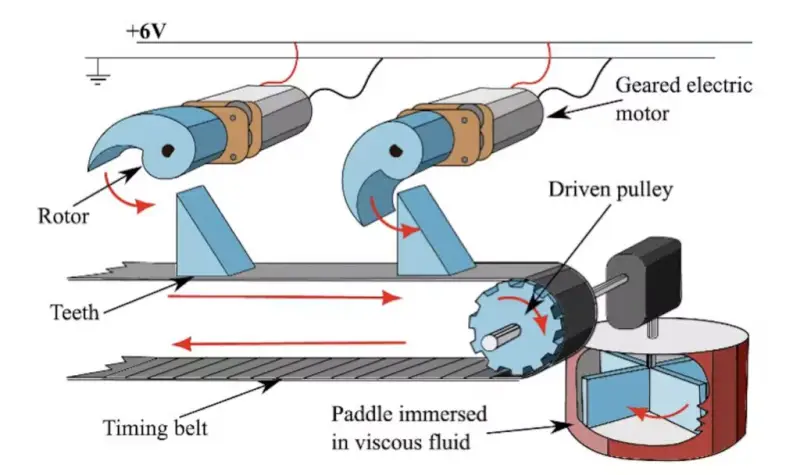
They also built a physical version: a row of ordinary electric motors linked through a shared moving backbone. The motors pulled against a thick fluid, which supplied resistance resembling the viscous load experienced by biological motors. The device generated force when supplied with current.
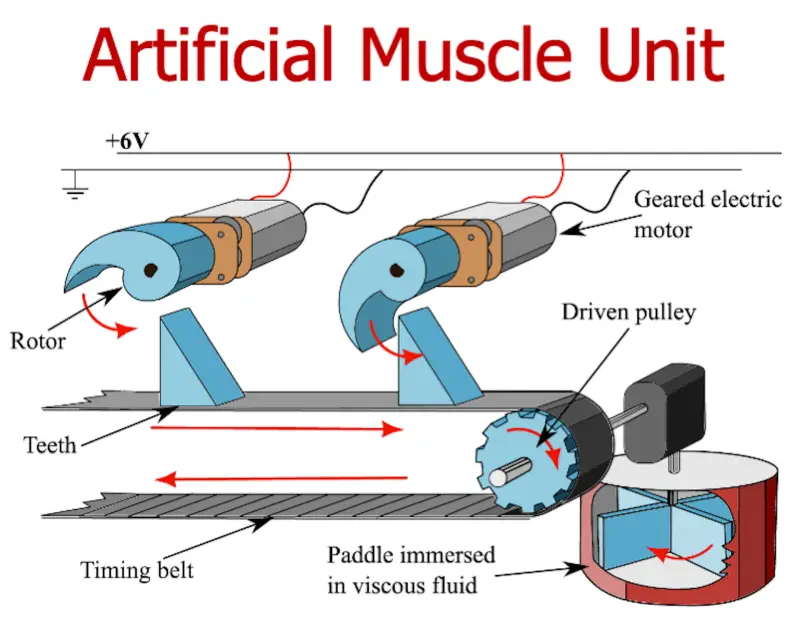 Illustration of the artificial muscle unit used in the study.
As the backbone moved, it transmitted the mechanical effects of an engaged motor to other parts of the array. The motors did not communicate directly, and they did not remain connected continuously. Each made contact, pushed on the backbone, then let go. The changing connections allowed force and motion to pass through the system over time.
Coordination changes with load
Both the mathematical model and the tabletop system developed muscle-like patterns. As resistance increased, the array showed a collective relationship between load and speed. More motors contributed effectively as the load rose, suggesting that participation in the work could change with mechanical demand.
The motion could also become uneven. Under some conditions, coordinated periods of pulling gave way to sudden slips, a pattern that echoes behaviour observed in actomyosin experiments. In other conditions, coordination formed travelling waves: activity passed along the motor array instead of all units acting in unison.
These results suggest that the arrangement of motors and the backbone can do part of the coordinating work. Each unit responds to its local mechanical connection, while the shared structure transmits the effects of that activity to other units. Collective behaviour can then emerge from the interactions, without the system needing to continuously direct every motor individually.
The model echoes a basic feature of the sarcomere: multiple force-producing units sit within a structure that transmits forces between them. The experiment does not reproduce the full chemistry or complexity of living muscle, but it offers a physical way to examine how connections between simple units might help produce coordinated movement.
From muscle to cilia and flagella
Muscle is one example of biological motors working together. Cilia and flagella also use many molecular motors arranged along a slender scaffold. Flagella include the tail that helps sperm move; cilia are hair-like structures found on many cells.
Their internal structure, called the axoneme, transmits forces along its length. Local motor activity bends the structure and can produce waves that travel along it. In sperm, those waves support movement; in cilia, they help shift fluid through airways and other tissues. The geometry and mechanical connections therefore help turn local motor forces into organised motion.
This parallel raises a broader question about how systems with many individual motors can remain coordinated and adapt to changing conditions without a central directing mechanism. The Bristol team’s model suggests that the body of a system—the scaffold and its connections—can contribute to the answer by shaping how forces pass between active units.
What it could mean for robots
Robots often rely on sensors, feedback loops and algorithms to coordinate multiple actuators. Gearing and other mechanical components can also help keep motion stable as loads change. Such arrangements can work well, but add complexity and create more points where errors can affect performance.
The motor array suggests another route worth exploring: build mechanical coupling into the actuator arrangement so that some coordination arises from the structure itself. That principle could inform soft robots, which use flexible materials, and artificial muscles designed to produce movement in a more adaptable way.
The study does not establish a ready-to-use robotic actuator or show how a particular robot would perform. Its contribution is a physical demonstration that simple motors can develop coordinated patterns under a shared mechanical setup. For engineers, the next question is how that principle might be shaped for a specific task, while accounting for the loads, materials and movement a robot needs to handle.
 AMD Venice Uses 2.5D Packaging to Feed More Bandwidth Into EPYC Zen 6
 CNC Controller Board Design: Interfaces, PCB Specs and Assembly Testing
 Stratasys and Nano Dimension End $42.5 Million Markforged Sale Agreement