SAWbot Uses a Single Motor to Swim and Traverse Rough Terrain
Ben-Gurion University’s SAWbot combines eel-like wave propulsion with treaded wheels, reaching 34 cm/s in swimming tests without reconfiguring its mechanism.
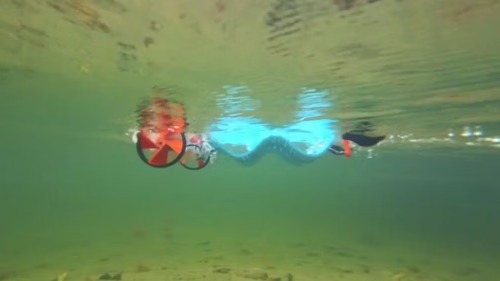
SAWbot’s engineering interest lies in how it handles two very different environments with one propulsion mechanism. Developed by researchers at Ben-Gurion University of the Negev, the amphibious robot swims by sending a continuous wave along a flexible body and travels over rough ground on large, treaded wheels. It can move between water and land without mechanical changes or adjustments.

One motor drives a travelling wave
In water, SAWbot uses anguilliform locomotion, the swimming pattern seen in eels and other elongated aquatic animals. Instead of relying on a propeller or articulated fins, it moves a flexible, sheet-like membrane in a wave that travels from one end of the robot to the other. The membrane pushes against the surrounding water, producing forward thrust.

The drive begins with a motor turning a rotating member inside the robot. That rotation pulls and pushes the membrane, which is stretched between two supports. The resulting up-and-down motion propagates along the body as a continuous travelling wave. A single motor therefore supplies the repeated motion used for swimming, while the flexible body converts that motion into thrust.

This arrangement keeps the swimming mechanism mechanically direct: rotation becomes membrane motion, and membrane motion displaces water. It also means propulsion depends on the wave moving along the body, rather than on a separate propeller or independently actuated fins. The available performance figures describe the resulting swimming tests, though they do not specify the motor’s power, the membrane’s material, or the wave frequency.
Wheels and floats support the two modes
On land, large wheels with deep grooves on both sides provide traction across rough terrain. The wheels supply the land-contact interface, while the flexible body and its wave mechanism remain part of the same vehicle. At the rear, two floats support the mechanism used to generate the swimming motion in water.

The electronics, control system and battery sit in the front chassis inside a sealed box intended to keep water out. That packaging choice puts the robot’s electrical hardware in a protected enclosure while the body and rear mechanism interact with the water. The description does not give an ingress protection rating, operating depth or water-resistance test conditions, so the sealing arrangement should be understood as a design feature rather than a stated environmental certification.

SAWbot’s change between land travel and swimming requires no mechanical reconfiguration. That matters for a vehicle expected to encounter both surfaces: an operator need not swap propulsion hardware or adjust the mechanism at the transition. The robot instead carries the wheels, floats and wave-generating body together, with each feature contributing in its relevant environment.
Swimming speed and advance ratio
In swimming tests, SAWbot reached speeds of up to 34 centimetres per second and an advance ratio of 0.73. The ratio compares the robot’s forward speed with the speed at which the wave travelled along its body. At 0.73, its forward motion was 73 per cent of that travelling-wave speed.
The researchers also measured the mechanical energy needed for the robot to travel a given distance. No energy figure or direct comparison is provided here, so the measurement indicates an evaluation method rather than a basis for ranking the design against other robots. Speed and advance ratio together describe how effectively the body wave translates into forward movement, but they do not by themselves establish endurance, efficiency across different water conditions or performance on particular land surfaces.
A compact mechanism with room to scale
The researchers describe the movement mechanism as relatively simple and suggest the design could be adapted into larger or smaller versions. That is a potential direction, not a demonstrated scaling result: changing size can affect the loads on the membrane, the motor requirements, buoyancy and how the robot interacts with the ground. The reported tests establish the current concept’s ability to swim and travel over rough terrain, while leaving those scaling questions open.
For engineers, the notable design choice is the integration of a travelling-wave swimmer with conventional wheeled land mobility. SAWbot shows how one motor driven membrane mechanism can provide aquatic propulsion while wheels handle ground travel, with sealed electronics and rear floats supporting operation across both settings. The next useful evidence would be performance data across varied surfaces and water conditions, alongside the energy measurements and details needed to assess larger or smaller implementations.
 CNC Controller Board Design: Interfaces, PCB Specs and Assembly Testing
 Stratasys and Nano Dimension End $42.5 Million Markforged Sale Agreement
 Xometry Q3 2026 Revenue Reaches $252.4 Million as Marketplace Margins Rise