VergeIO Uses Eye Vergence for Hands-Free Smart Glasses Control
VergeIO reads eye movements with four dry electrodes, reaching 97% accuracy on four depth gestures in tests with 20 participants.
VergeIO turns a small, continuous eye movement into a control input for smart glasses. Developed by researchers from Carnegie Mellon University, Tsinghua University and Wuhan University, the system detects when a wearer shifts focus between near and far objects, then maps that change to a command. The approach could let users interact with virtual objects at different apparent depths without reaching for a controller.

Reading the shift between near and far
The signal VergeIO uses is vergence: the inward rotation of both eyes when focusing nearby and their outward rotation when looking farther away. These coordinated movements happen naturally as a person changes focus. Unlike gaze tracking that identifies where someone is looking, VergeIO uses the change in eye alignment as the input.

That distinction matters for wearable control. A smart-glasses interface needs a signal that can be detected repeatedly while the wearer goes about ordinary tasks. Vergence offers a potential input channel that doesn’t require a hand gesture or voice command, though the system still has to separate intentional control patterns from routine changes in focus.
Electrode placement separates the signals
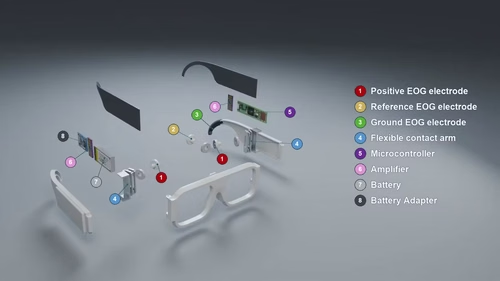
The prototype measures electrooculography (EOG), the electrical signals associated with eye movement. EOG sensors are already used in commercial eyewear, but distinguishing vergence from other eye movements is difficult because their electrical signals can interfere with one another.

VergeIO addresses this with an electrode arrangement designed to measure each eye independently. One electrode sits at each temple. A shared reference electrode rests on the bridge of the nose, and a fourth electrode behind the ear serves as ground. In practical terms, the layout gives the system separate left and right measurements to interpret as the eyes move together between near and far focus.
The prototype uses dry electrodes, which sense electrical activity through skin contact without adhesive or conductive gel. That avoids the added preparation those materials require, while making consistent contact between electrode and skin an important part of a wearable design.

Processing and power figures
A Teensy 4.1 microcontroller processes the signals in real time. The analogue sensing circuitry consumes 3 milliwatts (mW), and the researchers estimate that a 570 mAh battery could theoretically power approximately eight days of continuous sensing.
Those figures describe the sensing system and an estimated continuous-sensing scenario. They don’t establish runtime for a finished pair of glasses with displays, wireless links and other electronics operating at the same time. For product designers, the result is a useful indication that the sensing front end can be low power; total system endurance will depend on the rest of the hardware and how it is used.
Gesture accuracy and next steps
In tests with 20 participants, VergeIO achieved 97% accuracy across four depth-based gestures. When the gesture set expanded to all six possible gestures, accuracy was 77%. The difference shows the practical trade-off in adding control options: a larger gesture vocabulary may give users more commands, but the system’s recognition performance in these tests fell as that vocabulary grew.
The results are from a research prototype, so they don’t establish how the system will perform across longer periods of wear or in a commercial product. The reported figures do, however, point to a workable starting point for interfaces that use depth selection as an input. The team identifies selecting virtual objects at different depths and automatically adjusting varifocal lenses as possible applications. VergeIO could also support screening for certain vision disorders, though the source does not specify which conditions or describe a clinical validation.
For smart-glasses engineers, the central contribution is the combination of per-eye EOG measurement and vergence-based commands. The next test is whether the arrangement remains reliable during everyday wear, where natural focus changes, sensor fit and a broader set of gestures will all shape the user experience.
 Stark Future Orders Farsoon FS4X Printers for Titanium Motorcycle Production
 Rolls-Royce and INFINITY Plan Derby Manufacturing Hub for Nuclear Engineering
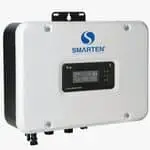 Smarten’s 3kW Grid-Tied Inverter Enters Pilot Production