MTA Urges UK Manufacturers to Invest Across Supply Chains
The MTA says production equipment, workforce skills and finance must reach smaller suppliers to build UK manufacturing capacity and resilience.

Manufacturing capacity depends on more than the factories that assemble finished products. Smaller suppliers need production equipment, skilled workers and access to finance too, the Manufacturing Technologies Association (MTA) argued at a briefing on November 12, 2026. Its central point: plans to expand domestic production will have little effect if investment fails to reach the businesses making components and providing specialist services.

The briefing, titled Advanced Manufacturing & National Resilience, was hosted by Lord Harrington, chair of manufacturing industry association Make UK. Speakers included Harrington, Jason Bowes, chief operating officer of manufacturing software company CloudNC, and MTA chief executive James Selka. They discussed productivity, adoption of manufacturing technology and suppliers’ ability to respond when supply chains are disrupted.

Capacity depends on suppliers throughout the chain
For the MTA, the practical measure of industrial ambition is whether it leads to more productive capacity. That means attention to the equipment behind a finished product: the machine tools, production systems and other technologies that allow suppliers to make parts at the required quality and volume. Selka said that resilience depends on what manufacturers can make, how quickly they can do it and whether their supply chains can respond when circumstances change.
This focus on the supply chain matters because a large manufacturer’s output relies on many smaller businesses. Those firms may produce components or carry out specialist processes, yet still face constraints on acquiring equipment, training staff and financing expansion. The MTA’s position is that investment needs to reach these businesses as well as the largest industrial operators. Otherwise, a production increase at one point in the chain may run into a shortage of capacity elsewhere.
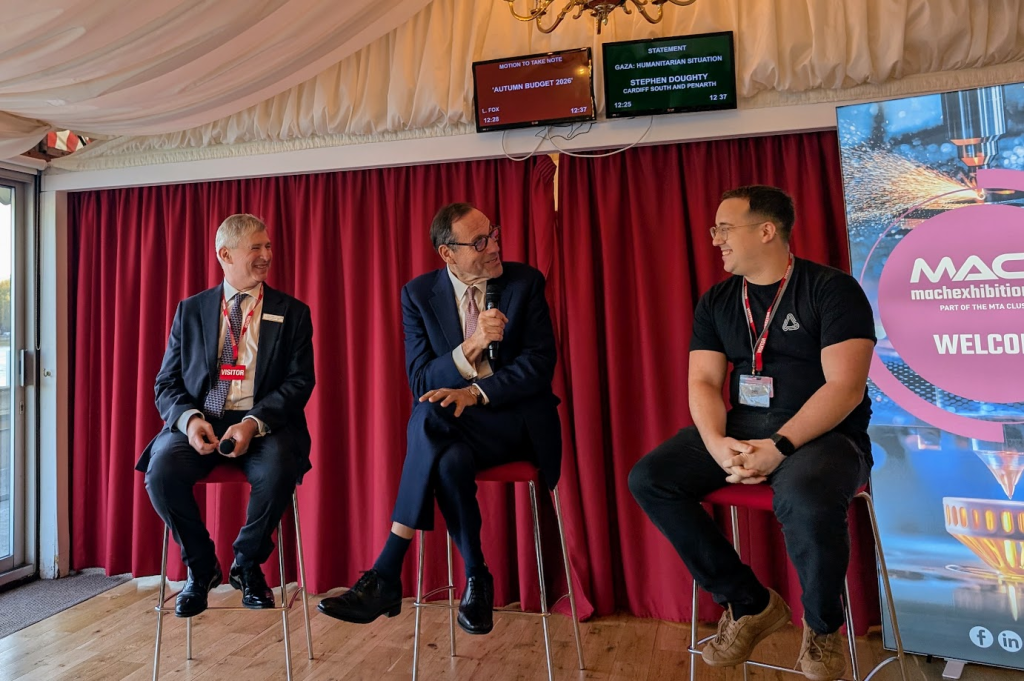
The discussion linked technology purchases with workforce development and access to finance. New equipment can expand what a factory is able to produce, but companies also need people who can operate and maintain it, integrate it into production, and apply it to customer requirements. The briefing did not set out a specific funding model or equipment programme. Its emphasis was on treating capital spending, technical capability and skills as connected parts of production growth.
Selka described sustained spending on manufacturing technology as necessary to build domestic capability. He also argued that stronger production capacity could help UK suppliers compete for demanding contracts and keep more high-value work in the country, including in aerospace. For manufacturers, the operational question is whether investment improves their ability to meet customer needs when supply conditions shift.
MACH links manufacturers with equipment suppliers
The MTA pointed to its MACH exhibition as one place where companies can assess technologies and speak with suppliers. Held at the National Exhibition Centre in Birmingham, the show gives manufacturers a setting to compare production equipment, explore technical options and consider how a new process might address a factory constraint before committing to a purchase.

That evaluation stage is significant. A machine’s relevance depends on the work it must perform, the processes already in place and the skills available to run it. Seeing equipment and discussing applications with suppliers can help a manufacturer narrow its options. The exhibition alone, however, cannot resolve the financial and workforce requirements that determine whether a proposed investment can be put into use.
MTA research indicates that about one fifth of manufacturing technology investments in the UK begin at MACH. The association also says business opportunities connected with the show can develop over a two-year cycle, extending beyond the five days of the exhibition. James Fudge, the MTA’s head of operations, characterized the event as part of the country’s manufacturing investment pipeline, with effects that may continue after exhibitors and visitors have left.
Those figures describe the association’s account of the show’s role. They point to MACH as a meeting point for companies considering equipment, rather than evidence that every discussion leads to a purchase. For suppliers, the event can create contact with potential customers; for manufacturers, it can provide a way to assess available technologies and identify possible solutions to production challenges.
Additive manufacturing adds another evaluation case
The 2026 MACH exhibition attracted approximately 26,000 visitors and more than 500 exhibitors, according to the MTA. It included a dedicated 3D Printing & AM Zone and Knowledge Hub, where manufacturers could assess additive manufacturing processes, materials and applications. That format gives production teams a chance to investigate how the technology might fit their needs before deciding whether to invest.
Additive manufacturing is one part of a broader equipment decision. Teams weighing a process need to consider the materials and applications relevant to their work, along with the technical capabilities required to use it. The event’s dedicated zone offered a place to examine those questions, but the briefing provided no specific performance results or adoption targets for additive manufacturing.
The MTA’s argument ultimately rests on follow-through. Equipment access can open options, but suppliers also need financing, trained staff and enough demand to expand production. The association is presenting MACH as one connection between manufacturers and available technology; its wider case is that investment needs to extend throughout the supplier base. For companies planning capacity, the useful measure will be whether those pieces come together in production.
=== Stark Future Orders Farsoon FS4X Printers for Titanium Motorcycle Production
 Rolls-Royce and INFINITY Plan Derby Manufacturing Hub for Nuclear Engineering
 Smarten’s 3kW Grid-Tied Inverter Enters Pilot Production