NTNU Silicone Patch Turns Wrist Pulses into Smartphone Camera Waveforms
NTNU’s battery-free PDMS patch reads wrist pulse waveforms through reflected colour, with early tests showing a 0.94 correlation to a clinical reference.

A thin silicone film could let an ordinary smartphone camera capture a wrist pulse waveform without electronics in the patch. Developed by researchers at the Norwegian University of Science and Technology (NTNU), the experimental sensor converts small changes in the skin over the radial artery into shifts in reflected colour. In tests with 13 volunteers, the waveforms extracted from phone video had a 0.94 correlation with a clinical reference measurement.

Artery motion becomes an optical signal
The patch is made from polydimethylsiloxane (PDMS), a flexible silicone. It sits over the radial artery, where each pulse slightly expands the artery and stretches the surrounding skin. A nanostructured grating on one face of the film reflects different wavelengths of light according to the spacing between its ridges. As the skin stretches, that spacing changes, shifting the reflected light.

The phone camera records the resulting colour changes. Analysis of the red, green and blue components in the video is then used to recover the pulse wave shape. The patch itself contains no battery, wires or electronic components; the camera supplies the optical readout, while the smartphone handles video capture and signal processing.
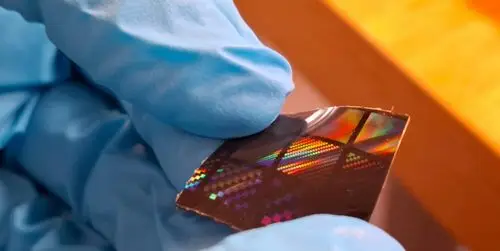
NTNU researchers report that a 2 per cent stretch produced a 9 per cent change in wavelength reflection intensity. The optical response remained stable over 1000 cycles. Those figures describe the patch’s response under the reported test conditions; they don’t establish how it will perform across different users, phones or everyday movement.
What changes compared with conventional pulse sensors
Conventional photoplethysmography (PPG) sensors illuminate tissue and use electronic detectors to measure changes associated with blood volume. This patch instead makes the skin’s pulse motion visible as a change in reflected colour, leaving the smartphone camera to observe that signal.

The researchers say the patch performed better in comparative measurements than active reflectance PPG, imaging PPG and piezoelectric pulse sensors. The reported 0.94 correlation with a clinical reference is promising, but it comes from a small study involving 13 volunteers. The available results don’t establish clinical accuracy across a broader population or show that the patch can replace an established measurement device.

Moving the detector function to a phone also makes the camera part of the measurement chain. Differences between phone cameras may affect how the colours are captured and analysed. The team also identifies skin tone as an area needing further investigation. These variables matter because the method depends on extracting a small optical change from video, rather than reading a direct electrical signal.
Adhesion and manufacturing
A second textured face of the patch uses an adhesive pattern inspired by octopus suckers. According to the researchers, this design increased shear adhesion to skin by 65 per cent compared with a flat film. That added grip is relevant to a sensor whose signal depends on the patch following fine movements at the wrist.
Both textured surfaces are made by large-area nanoimprinting. The researchers report that fabrication was possible outside cleanroom conditions, a process detail that could simplify production. The results don’t provide a production cost, manufacturing yield or commercial availability, so those practical questions remain open.
Early-stage measurements, with motion still a problem
The wrist is a challenging measurement site: movement of the wrist and the skin can also change the reflected colour, making those effects difficult to distinguish from the pulse. The 13-person study involved healthy volunteers, and the reported accuracy has not been verified more broadly. The technology remains experimental and has not been approved as a medical device.
A camera-readable patch could be useful where conventional measurement equipment is unavailable, but that possibility depends on resolving the limits identified so far. The next practical evidence to watch for is how consistently the waveform can be recovered across different cameras, skin tones and levels of motion. For now, the work demonstrates a compact optical sensing approach, while leaving its reliability beyond controlled tests to be established.
 Stark Future Orders Farsoon FS4X Printers for Titanium Motorcycle Production
 Smarten’s 3kW Grid-Tied Inverter Enters Pilot Production
 L&T Technology Services’ SDVault.ai Targets Traceable Software-Defined Vehicle Development